Japanese Tea Ceremony at Home: A Simplified Guide for Beginners
Chanoyu has a reputation problem. From the outside it looks like a locked room full of rules: the right bowl, the right cloth, the right way to turn your wrist. The full ceremony does take years to learn. But the heart of it — one person quietly making a bowl of tea for another — needs a whisk, a bowl, and about ten minutes. What follows is the beginner's version, the one you can do on a Tuesday morning before work.
What the Ceremony Actually Is
Chanoyu, also called sadō or chadō, the way of tea, is less a performance than a structured form of hospitality. A host prepares matcha for a guest with undivided attention; the guest receives it with attention of their own. Everything else — the scroll, the flowers, the charcoal — exists to support that exchange.
For home practice you only need the simplest form: usucha, thin tea, whisked and served in one bowl. The thicker, more concentrated koicha comes later, if it comes at all. The various schools differ in how they fold a cloth or place a ladle. You don't have to choose one to begin.
The Mindset Matters More Than the Tools
Tea teaching rests on four principles: wa, kei, sei, jaku — harmony, respect, purity, tranquility. They sound abstract. In practice they are instructions.
- Harmony means moving in a way that fits the room you're in, not the room you wish you had.
- Respect means handling the bowl, the whisk and your guest as though they matter.
- Purity means clean tools and a clean surface. Not sterile — cared for.
- Tranquility means you don't rush, even when the kettle is loud.
There is also ichigo ichie, "one time, one meeting" — this bowl, this person, this afternoon will not come around again. You don't need to feel sentimental about that. Noticing it does most of the work of slowing you down.
The Minimum Kit
You can spend a fortune on utensils. Don't, not yet. Start with these:
- Chawan — a tea bowl. A wide shape is easier to whisk in than a tall mug, and a cereal bowl from your cupboard is a legitimate first chawan.
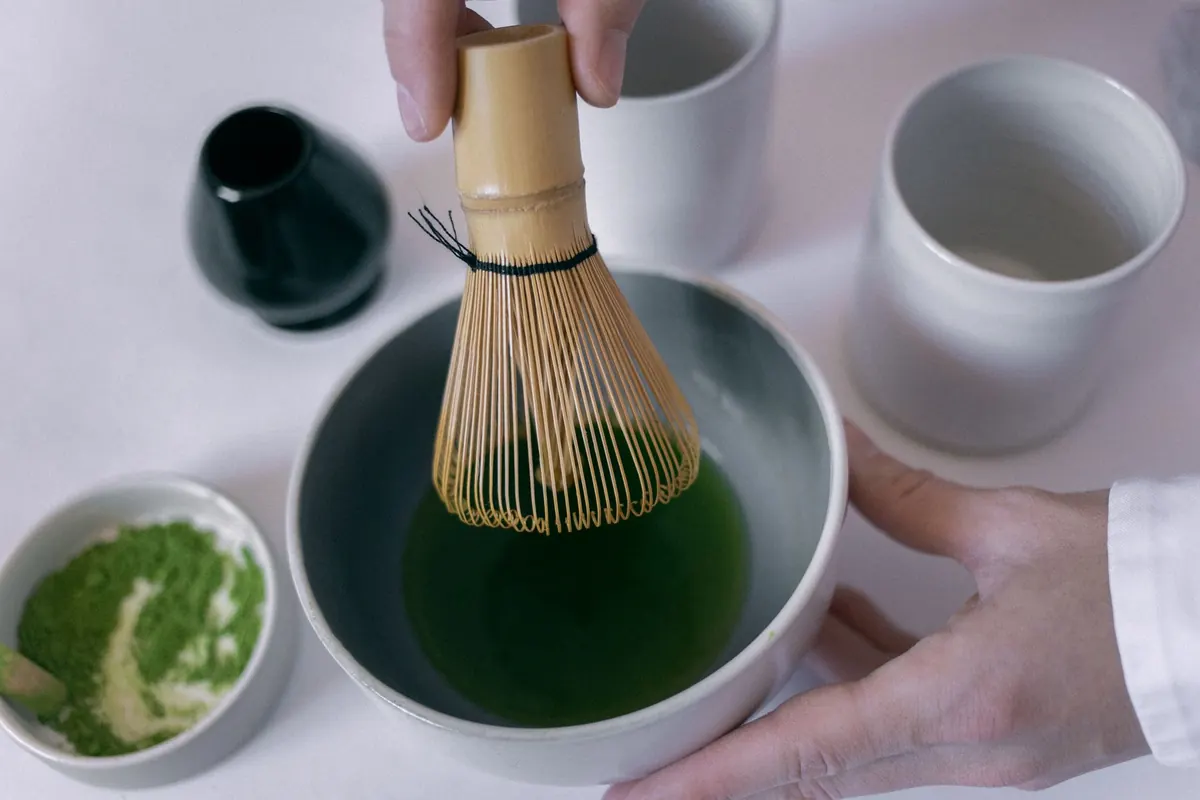
- Chasen — a bamboo whisk. Electric frothers make foam, not usucha. A basic whisk lasts months if you treat it kindly.
- Chashaku — a bamboo scoop. A small spoon will do while you decide how far you want to go.
- Matcha — drinking grade, not culinary. Culinary matcha is made for baking and will teach you the wrong lesson about how tea should taste.
- Chakin — a small cloth for wiping the bowl. A square of clean linen does the job.
- Kettle — any kettle. You'll be cooling the water, not boiling it.
Store matcha sealed and away from light and heat. If you keep it in the fridge for a long stretch, let the tin come to room temperature before opening so condensation doesn't get inside.
A First Bowl, Step by Step
- Put the kettle on. While it heats, set out your bowl, whisk, scoop and matcha, and clear the space around them. This part matters as much as the whisking.
- Sift about two scoops — roughly a level teaspoon — of matcha through a small strainer into the bowl. Skipping this step is the usual reason home matcha tastes clumpy.
- Warm the bowl with hot water, swirl it, pour it out, and dry the inside with your cloth. A warm bowl keeps the tea hot and shows the bowl at its best.
- Let the water cool. Usucha is made with water around 80°C, not boiling. Easiest method: pour boiling water into a teacup, wait a minute or two, then use that.
- Add about 60–70 ml of the cooled water to the matcha — a quarter cup, roughly.
- Hold the bowl steady with your left hand. Whisk with your right in a quick W or M motion, keeping the whisk near the bottom and moving from the wrist, not the shoulder. Fifteen to twenty seconds. You want fine, tight bubbles, not meringue.
- Lift the whisk straight out of the center so you don't knock the foam down. Drink it warm, in two or three sips, before it separates.
Receiving a Bowl, and Offering One
If you're making tea for someone else, the ritual is mostly about attention. Carry the bowl, offer it with both hands, and let your guest drink first. Sit nearby rather than hovering over them.
As a guest, receive the bowl with both hands and a small bow. The decorated side usually faces you when the bowl is handed over; turn it a quarter-turn so that front faces away, a quiet gesture of modesty. Drink. Wipe the rim where your lips touched with your fingers or a small cloth. Turn the bowl back and return it. A word about the tea is welcome; a monologue is not. That's the whole etiquette, and nobody is watching for mistakes.
Practising Without Going Stiff
Frequency beats duration. Five minutes three times a week will teach your hands more than a ninety-minute session once a month. Choose one thing per session: the whisking motion, the way you set the bowl down, or simply breathing out before you pour. One thing is enough.
Care for the whisk afterwards. Rinse it in warm water — no soap, ever — shake it out, and rest it on a whisk stand or prongs-up in a small cup so the bamboo doesn't deform. Let the bowl air-dry when you have time. If you want to go further, one in-person lesson will teach you more about posture and rhythm than a hundred videos. Look for a tea group or a class at a local cultural centre and bring your questions.
A Simple First Month
Week one, gather the kit and make a single bowl. Week two, work on the whisking. Week three, invite one person to drink with you. Week four, do the whole thing slowly from start to finish and notice which part you still rush.
Keep the setup small enough that you'll actually use it. Equipment that lives in a box at the back of a cupboard doesn't get used, and the practice dies quietly. A tray with the bowl, whisk and matcha on an open shelf is enough.
Your first bowls will be lumpy, lukewarm or over-whisked. That's expected. The point was never the perfect foam — it's the ten minutes you spent paying attention to water, bamboo, and whoever is sitting across from you.
Photo: KATRIN BOLOVTSOVA / Pexels